Selecting the right insulation material for a commercial or industrial project is one of the most important decisions in the specification process. The material you choose affects thermal performance, fire safety, acoustic control, compliance and long-term lifecycle costs. Get it right, and you gain decades of reliable performance. Get it wrong, and you face costly replacements, compliance failures or, in the worst case, serious safety risks.
Unlike residential insulation, where choices are relatively straightforward, commercial and industrial applications demand a more considered approach. Operating temperatures can range from sub-zero in cold storage through to 750°C and beyond in power generation and process piping. Fire performance requirements under the National Construction Code (NCC) are stringent, and acoustic performance may need to meet specific engineering targets.
This guide provides a practical comparison of the most commonly used commercial and industrial insulation materials, helping you understand where each one performs best and what to consider before specifying.
1. The Main Types of Industrial Insulation
There are five insulation material categories that account for the vast majority of commercial and industrial applications in Australia. Each has distinct properties that make it suitable for different temperature ranges, environments and compliance requirements.
Rockwool (mineral wool / stone wool)
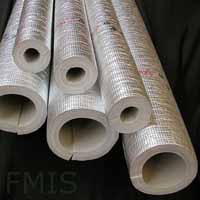
Rockwool is manufactured by heating natural basalt rock to extremely high temperatures, then spinning the molten material into fine fibres. The result is a dense, non-combustible insulation product available as slabs, wired mats, blankets and moulded pipe sections. According to ROCKWOOL Group, stone wool fibres can withstand temperatures above 1,000°C without melting, making rockwool one of the most fire-resistant insulation materials available. It is widely used in power generation, process piping, industrial equipment, HVAC systems and fire-rated wall assemblies. Rockwool also offers strong acoustic absorption properties, with Noise Reduction Coefficient (NRC) values typically ranging from 0.85 to 1.00 depending on density and thickness.
Fibreglass (glasswool)
Fibreglass insulation is made from fine glass fibres and is one of the most widely used insulation materials in Australia. It is lightweight, cost-effective and performs well in low to moderate temperature applications up to approximately 350°C. Some unfaced fibreglass products are classified as non-combustible under AS 1530.1. Fibreglass is commonly used in commercial building envelopes, HVAC ductwork and lower-temperature pipe insulation. It is available as pipe sections, blankets and rigid boards.
Polyethylene foam
Closed-cell polyethylene foam is primarily used for chilled water and refrigeration piping, typically in applications ranging from -70°C to +95°C. Its closed-cell structure provides an integrated vapour barrier, reducing the risk of condensation on cold pipes. Polyethylene is lightweight, easy to install and resistant to moisture ingress. However, it is a combustible material and is not suitable for high-temperature or fire-rated applications.
Ceramic fibre
Ceramic fibre insulation is designed for extreme high-temperature environments, with some products rated for continuous use at temperatures exceeding 1,200°C. It is used in furnace linings, kilns, exhaust systems and other specialised industrial applications. Ceramic fibre is available as blankets, boards, paper and bulk fibre. Due to health and handling considerations, its use is generally confined to industrial settings with appropriate safety controls.
PIR / rigid board systems
Polyisocyanurate (PIR) rigid boards offer high thermal resistance per unit thickness, making them useful where space is limited. They are commonly used in commercial roofing, wall cladding and cold storage applications. PIR boards have an upper temperature limit of approximately 120°C to 150°C and are combustible, though they are typically faced with foil or other materials to improve fire performance. They are not suitable for high-temperature industrial applications.
2. Temperature Range Comparison
One of the first considerations when selecting insulation is the operating temperature of the system or surface being insulated. Choosing a material that cannot withstand the service temperature will result in degradation, loss of thermal performance and potential safety hazards.
| Material | Min. Temp | Max. Continuous Temp | Typical Applications |
| Polyethylene foam | -70°C | +95°C | Chilled water, refrigeration |
| PIR rigid board | -50°C | +120°C to +150°C | Cold storage, commercial roofing |
| Fibreglass | -183°C | +350°C | HVAC, building envelope, process piping |
| Rockwool | -183°C | +750°C | Power stations, industrial equipment, fire protection |
| Ceramic fibre | N/A | +1,200°C+ | Furnaces, kilns, exhaust systems |
For low-temperature applications such as chilled water systems, polyethylene foam is often the preferred choice due to its built-in vapour barrier. For medium-temperature HVAC and process piping, both fibreglass and rockwool perform well. For high-temperature industrial applications, including power station maintenance, equipment insulation and fire-rated assemblies, rockwool is the standard choice. Only ceramic fibre should be considered for extreme temperatures above 750°C.
3. Fire Performance Differences
Fire performance is a critical specification requirement for commercial and industrial insulation, particularly in multi-storey buildings, power generation facilities and any application where the Building Code of Australia (BCA) mandates non-combustible construction.
In Australia, the primary test for non-combustibility is AS 1530.1. This is a severe test in which material samples are placed in a furnace at 750°C for at least 30 minutes. If the sample flames for more than five seconds during that period, it is classified as combustible. Rockwool and some unfaced fibreglass products consistently pass this test and are classified as non-combustible.
Polyethylene foam and PIR rigid boards are combustible materials. While they may incorporate flame retardants or protective facings, they cannot achieve non-combustible classification under AS 1530.1. This limits their use in fire-rated assemblies and applications where non-combustible construction is required.
Where rockwool particularly excels is in fire resistance testing under AS 1530.4, which measures how long a building element can maintain structural adequacy, integrity and insulation during a fire. Rockwool products are used in fire-rated wall, floor and penetration systems achieving Fire Resistance Levels (FRLs) of up to 120/120/120 and beyond. The softening temperature of stone wool fibres exceeds 1,000°C, meaning the material retains its shape and insulating properties even under extreme fire conditions. For projects requiring fire-rated pipe penetration systems, rockwool is the material of choice.
4. Acoustic Performance
Sound control is an often-overlooked aspect of insulation specification, yet it can be critical in commercial buildings, industrial facilities, HVAC systems and partition walls.
Rockwool offers the strongest acoustic performance among common insulation materials. Its dense fibre structure absorbs sound waves effectively across a broad frequency range. At 100 kg/m³ density, rockwool achieves sound absorption coefficients above 0.95 at mid-range frequencies (500 Hz to 1,000 Hz), making it suitable for acoustic barriers, partition walls, plant rooms and ceiling systems.
Fibreglass also provides reasonable acoustic performance, particularly in lightweight wall and ceiling assemblies. However, its lower density compared to rockwool generally results in reduced sound absorption at lower frequencies.
Polyethylene foam and PIR boards have limited acoustic absorption properties. Their closed-cell structures reflect rather than absorb sound waves, making them unsuitable as primary acoustic insulation materials.
For projects where acoustic performance is a priority, such as theatres, studios, hospitals, commercial offices or plant rooms adjacent to occupied spaces, rockwool is typically the recommended material. The combination of thermal, fire and acoustic performance in a single product simplifies specification and reduces the need for additional acoustic treatments.
5. Cost vs Lifecycle Value
It is tempting to compare insulation materials purely on upfront cost per square metre. However, this approach can be misleading when the full lifecycle of a project is considered.
Fibreglass and polyethylene foam products typically have lower upfront material costs than rockwool. However, rockwool’s superior durability, dimensional stability and resistance to moisture mean it maintains its thermal performance over a longer service life. Rockwool does not sag, settle or lose R-value over time, even under varying temperature and humidity conditions. This reduces the likelihood of costly maintenance, replacement or remediation.
In industrial settings where insulation is subject to mechanical stress, vibration, moisture exposure or high operating temperatures, choosing a lower-cost material that degrades faster can result in significantly higher total cost of ownership. Replacement insulation work on operating plant or equipment also involves downtime costs that often far exceed the original material investment.
PIR boards, while offering excellent R-value per thickness, are limited by their temperature range and combustibility. In applications where fire performance or high-temperature resistance is later found to be necessary, the cost of stripping and replacing PIR with a suitable alternative can be substantial.
The most cost-effective approach is to specify the right material for the application from the outset, taking into account operating conditions, compliance requirements, expected service life and maintenance access.
Key Questions to Ask Before Specifying
Before selecting an insulation material for your next commercial or industrial project, consider the following questions:
What is the operating temperature range? This is the single most important factor in narrowing your material options. Ensure the insulation is rated for the maximum continuous service temperature of the system.
Is non-combustible construction required? Check the NCC requirements for your building class and construction type. If non-combustible materials are mandated, combustible options such as polyethylene and PIR are excluded.
Are there acoustic performance targets? If the project includes noise-sensitive areas or requires specific Sound Transmission Class (STC) or NRC ratings, select a material with proven acoustic absorption properties.
What is the expected service life? Consider how long the insulation needs to perform and whether the installation will be accessible for future maintenance or replacement.
What are the environmental conditions? Assess exposure to moisture, vibration, chemicals and UV to ensure the material will maintain its performance over time.Every project has unique requirements, and the right insulation material depends on a careful assessment of all these factors. If you are unsure which material best suits your application, our technical team at FM Insulation can provide tailored advice based on over 30 years of industry knowledge. Contact us to discuss your project requirements.